Good things happen near the football, so run to it.
I heard Joe Buck say this last Sunday during his weekly broadcast for the NFL. Coming from a lifetime of playing and being around sports, I have heard the phrase (and many others like it) countless times. So, I’m not sure what was different about when he said it last week, but it affected me more than any time before.
The context was something like an offensive lineman hopping on a football ten yards downfield after his running back fumbled. Fans cheered, teammates got fired up, and coaches yelled praise. It was a hustle play. Good things happen near the football, so run to it.
It got me thinking: what can we learn from this phrase in a business context? And what is my “football”?
Well first, let’s look at how it applies in business.
I think it’s a testament that not much gets people more excited than effort. Especially when that effort comes from someone who isn’t “supposed to make the play”. The only reason the offensive lineman had the opportunity to save the possession was because he was giving 100% effort, even when he wasn’t supposed to be needed. Effort transitions into momentum. Momentum keeps a team moving forward, avoiding a misstep, and continuing toward the endzone.
In business, every day is urgent. Technology is improving and competition is getting smarter. If you take a misstep, it could set you back months or years. Then all the sudden, someone makes a play they’re not supposed to make and saves you time, energy, and money. The whole team benefits. All because they understood the impact of staying near the action.
The deeper layer is that “good” things only happen if you successfully make the play. No one would be praising the offensive lineman if he was in the right place but then botched the recovery. Instead, they would probably make a joke about “that’s why he’s not a receiver” and move on to the commercial break.
Which means it’s not just effort that leads to success in those situations, but also preparation. Preparation comes from good coaching. Coaching that stresses the importance of understanding all parts of the game and doing the little things right. Any person can be a playmaker, but they need to be near the action and prepared to succeed when they get there.
And what is my “football”?
Well, that’s a hard question to answer. I think it probably would represent my goals in general. I had a friend of mine say to me recently, “You’re not going to get what you want unless you tell people that you want it.” His point being that you can have all the goals you want, but you are going to need help to achieve them. In short, if you put yourself close to the action, you give yourself the opportunity to succeed.
What does it all mean?
Maybe nothing. I might just be romanticizing an off-hand comment from a lazy Sunday that didn’t have much else to think about.
But if you want to see it deeper, then I think it means to make sure people know what you want. Put yourself out there, interact on linkedin, make time for conversations, stay in touch via email; these are all ways of staying near the action.
And as we now know, good things happen near the football, so run to it.
What types of companies survive during trying times? And how does a good leader separate themselves from the pack?
These are questions that I have been reflecting on over the past twenty months. It was extraordinary to watch who stepped up at my company, Alliance Exterior Construction, when crisis was striking in March of 2020. There was unrest and uncertainty among our employees, but our Owner and President Korky Bowling was a stout leader throughout and projected confidence that inspired us all. He started the company thirty-two years ago, built it to where it is today, and has survived an unending number of challenges in doing so. I recently asked Korky why he gets up every day to do what he does; he explained that “I always wanted Alliance to be the best damn contractor it could be.”
That why describes Korky’s beliefs, and at a small company like ours, the Owner’s beliefs trickle down into everything we do. Those beliefs end up becoming Alliance’s mission, which drives us every day.
So, what types of companies survive and thrive during trying times?
In a crisis such as COVID-19, the groundwork had to be laid far before March of 2020. Leaders needed to ensure their workforce was prepared for any type of situation. Their people needed to be flexible as information and policies changed, resolute in their trust of leadership and the company, and have a strong sense of why they do what they do that was consistent across the business. In short, they needed to understand the mission.
Building a set of values allows employees and clients to understand what you believe as a company. Building a mission allows your employees to understand why they come to work every day and the greater whole that they are working towards. For a company to survive and thrive in trying times, leaders must therefore start with a strong mission that describes to their people exactly why they should keep fighting forward even when times are tough.
Mission in the Nonprofit Sector
The best examples of how a strong mission can inspire companies come to us from an unsuspecting place: nonprofit organizations. We often think of nonprofits in a totally different category from for-profit businesses, but from a management and strategy perspective, there is a significant amount we can learn from them.
Consider this: according to the University of Maryland’s Do Good Institute in 2020, the value of a volunteer hour was worth $28.54/hour1. That means that for every hour spent volunteering, the non-profit organization is getting the same value out of that person that they would from someone who they paid $28.54/hour! And instead, the organization got that value for free. Do you see what I’m getting at here? Why would someone worth $28.54/hour (almost triple minimum wage in most states) instead work for FREE? The answer is because they believe in the mission of the organization. Figure 1 shows the percentage of the population volunteering in the U.S. from 2008 to 2017. Based on this data, volunteers contribute nearly $200 billion to our communities each year.
Figure 1: Percentage of population volunteering in the U.S. from 2008 to 2017 Source: Statista 2021
Further, management guru Peter Drucker describes the effect of the mission of a nonprofit in his book, The Essential Drucker (2008) as follows:
Starting with the mission and its requirements may be the first lesson business can learn from successful nonprofits. It focuses the organization on action. It defines the specific strategies needed to attain crucial goals. It creates a disciplined organization. It alone can prevent the most common degenerative disease of organizations, especially large ones: fragmenting their always limited resources on things that are “interesting” or look profitable rather than concentrating them on a very small number of productive efforts. (p.41)
Mission breaks through all the noise that a company and its employees hear daily. It allows them to understand what’s important and how they should make their decisions or prioritize their actions.
Consider Habitat for Humanity. Their mission statement is “Seeking to put God’s love into action, Habitat for Humanity brings people together to build homes, communities and hope.” Isn’t that so easy to understand? And doesn’t it clearly demonstrate why it is worth your time to volunteer instead of needing money as a driver for action and success? You don’t need to pay people for them to put in hard work, but you need to demonstrate to them that they are a part of something bigger than themselves. Businesses would do well to better understand how their missions can inspire their employees to do the same.
Mission in the For-Profit Sector
I stumbled across a company recently, Duolingo (DUOL), that embodied the type of mission that businesses should be striving for. Their website explains their mission as follows:
There are over 1.2 billion people learning a language and the majority are doing so to gain access to better opportunities. Unfortunately, learning a language is expensive and inaccessible to most.
We created Duolingo so that everyone could have a chance. Free language education – no hidden fees, no premium content, just free.
Duolingo is used by the richest man in the world and many Hollywood stars, and at the same time by public schools students in developing countries. We believe true equality is when spending more can’t buy you a better education.
That is a company that gets it. They aren’t telling their employees to, “make us as much money as possible by building an app that teaches languages”. They are telling them to focus on the fact that what they’re doing is ultimately providing free education for people around the world that wouldn’t have access to it otherwise. Imagine going to work every day to drive towards that goal. There will obviously be employees that don’t jump into the boat, but for the majority this is going to lead to higher quality, more productive work. People are willing to give extra effort, but you must show them why the extra effort is worth it beyond more money in their pocket.
Conclusion
In conclusion, surviving and striving in trying times starts with good leadership and a strong mission. That mission lays the groundwork for the work the company performs and will allow the company to survive hardships and thrive well after they have passed. Nonprofits can teach us so much about creating a mission that illustrates the greater good and why we go to work every day. This is critical not just for company success, but also for creating a culture where your employees are proud of their work and have a high sense of their worth. Which all leads to better quality of life.
I’ll leave you with this: I have been trying to define Alliance’s mission statement going into the future, but for it to be effective, it must be consistent with Korky’s beliefs that have built the company to where it is today. Below is my effort at this so far, let me know what you think.
Alliance Exterior Construction’s Mission
“To elevate Alliance’s people and their families to a higher quality of life; to elevate our business to be the best contractor we can be; to elevate our community by prioritizing a happy and safe environment for all.”
The building industry is unique in that its end-product, i.e., the building itself, contributes to society and often serves a greater good. Have you ever been involved in the construction of a hospital? How about a university building? Or even an apartment complex? Then you have contributed to society by improving health care facilities, educational centers, or even housing! This is a satisfying reward for a job that can often be taxing; you get a tangible product that will stand as proof of your hard work. Beyond being a symbol of your accomplishments, new buildings can be a symbol of what the future holds for the community in which it’s built. Over time, people will actually interact with it, utilize its features, and learn to live around and within it. Designers, architects, engineers, and constructors have the special opportunity to shape the future with each new construction project. But as they say, with great power comes great responsibility, and contributing to society means more than just providing a functioning building. It also means ensuring that the building is sustainable for the community and environment in which it’s built.
Sustainability is a term that is often used, and sometimes scoffed at in our industry. It is frequently referenced in a universal sense, and the typical individual is not properly educated on how their individualproject could make a difference toward contributing to a more sustainable future. They may recognize that building sustainably is generally a good thing, but do they understand the impact of each building on the environment? Therefore, the goal of this paper is to give some credibility behind the need for sustainable design and construction by educating industry professionals on embodied carbon and its role in the building industry. I’ll define sustainability and embodied carbon, the effect of concrete on a building’s carbon footprint, and look at some alternative building products that could benefit the environment. From there, one should have a higher ability to recognize environmental impacts on their projects and how each project can make a difference.
What do we mean by “sustainability”?
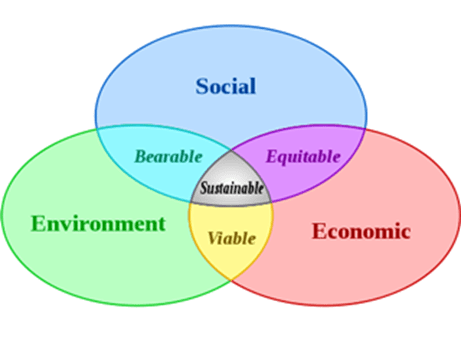
Figure 1: The Three Pillars of Sustainability
Building designers and engineers are tasked with an extremely difficult equation: how does one design a building that serves its function, fits the community, and is built with an environmentally friendly approach? This is inherently what we mean by sustainability. Figure 1 illustrates the “triple bottom line” of sustainability which are: social benefits, environmental effects, and economic viability. Achieve all three, and you have yourself a sustainable building.
This means finding products that allow structures to be built with the end-users in mind first, at cost-effective prices, while minimizing environmental impact. It’s therefore important to remember that it is not just building operation that causes an environmental impact through energy consumption, but also the materials and energyconsumed in the actual construction of the building. Architecture 2030 explains that buildings generate nearly 40% of annual global CO2 emissions, with building operations responsible for 28%, and building materials and construction (typically referred to as embodied carbon) responsible for an additional 11%1. A prime contributor is cement. “Cement is responsible for 7% of global greenhouse gas emissions, and is predicted to grow with increasing development,” write Jane Anderson and Alice Moncaster (2020). Cement is used in concrete, and as I write this, no material is used more frequently in buildings worldwide than concrete2; further, the embodied carbon content of concrete is significant.
What do we mean by “embodied carbon”?
Simply put, embodied carbon refers to the amount of greenhouse gas emissions (like CO2) that stem from the production, transportation, installation, and removal of a material.3 As a result, each building that is constructed inherently comes with a baseline carbon footprint that is unchangeable simply based off the materials that are used in its construction. Designers can be creative in the types of systems that operate the building to reduce CO2 emissions over the life cycle of the building, but this doesn’t change the amount of greenhouse gas emissions it took just for the building to be exist in the first place. Leadership in environmental design of building materials (and how they get to the job site and installed on the building) is therefore paramount.
Can you provide an example?
The manufacturing of a cubic yard of concrete is equivalent to releasing about 400 pounds of CO2, which is about the same as the average tank of gas in a car4. Assuming a ten-story building with approximately 24,000 cubic yards of concrete, this translates to 9,600,000 pounds of CO2, or 7,200,000 miles driven by a car (which is like driving back and forth from Los Angeles to New York 2,942 times). And that is just for one ten-story building! So, the environmental cost of concrete is obviously significant when extrapolated across projects all over the world.
What is being done about it?
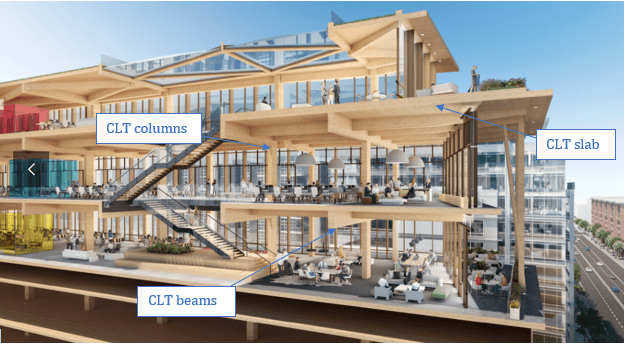
Figure 2: Cross-Laminated Timber
While there is a long list of measures that industry leaders, like the US Green Building Council (USGBC), are taking to reduce the carbon footprint of buildings through LEED and other initiatives, one that is especially exciting is the use of mass-timber in lieu of typical steel and concrete structures on high rise buildings. Cross-laminated timber (CLT) is growing in popularity in “heavy” applications and will continue to do so. Figure 2 shows the makeup of CLT, which is layers of timber laminated in alternating directions to provide rigid wood “panels” that can be used for floor slabs, beams, or columns. Its use has been popular in Europe over the last decade, but it has taken some time to gain traction in the United States. The 2015 International Building Code allows its use in certain situations, but the 2021 International Building Code will have expanded allowances and new building types for mass timber structures to encourage more mass timber construction5. It’s worth noting that using wood products obviously results in cutting down trees, which are fantastic carbon sinks (where CO2 is taken out of the environment rather than put into it). Therefore, to optimize its environmental impact, CLT must be harvested from a sustainably managed forest. If done correctly, mass timber can have a much lower embodied carbon value than concrete.
As a proof of concept in the United States, the 80 M Street Project in Washington D.C. is scheduled to be complete in 2022, and is the first office building in D.C. to utilize mass timber construction (see the end of this post for renderings of this project).
Façade products with a focus on embodied carbon
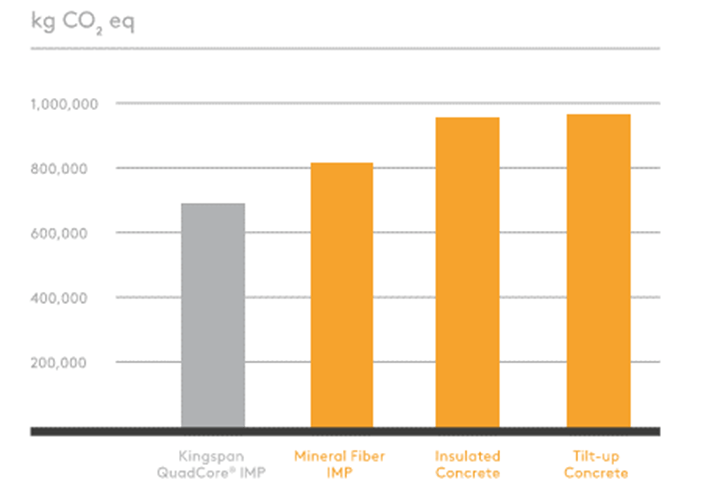
My background and career are in exterior façade systems, which are installed well after a building’s structure is in place. However, I recognize that exterior building components can also have a significant effect on the embodied carbon of a construction project and am in the fortunate position of being exposed to a variety of wall cladding materials. There are many manufacturers that are attempting to optimize sustainability, cost, and overall building performance, but a few are clearly leading the way. In doing research, one product, the Kingspan Quadcore Panel, caught my eye specifically. In 2020, Kingspan released a study on “Reducing the Embodied Carbon of Walls in Industrial Buildings”, which I found fascinating because it applied so directly to this topic, but also because I had no idea that this report existed! I’m sure there are designers and engineers that are aware of it, but again I believe this proves my point that the typical industry professional isn’t aware that embodied carbon is a problem that each of us must assist in resolving. The report (2020) establishes that Kingspan’s “Quadcore” panel’s Global Warming Potential is 28% lower than insulated concrete and tilt-up concrete panels, which have significantly higher levels of embodied carbon6. This is illustrated by Figure 3 below. Again, finding alternates to concrete building materials is an important step towards improving the built environment in our structures and façades alike.
Figure 3: Global Warming Potential of Various Façade Products Source: Report on “Reducing the Embodied Carbon of Walls in Industrial Buildings” by KieranTimberlake
Conclusion
In conclusion, sustainability and embodied carbon need to continue to grow as topics of discussion amongst the common building industry professional. It’s important that manufacturers continue to take initiative on reducing embodied carbon, but there is also an onus on us to educate ourselves as well. Each project can make a difference.
2Anderson, J., & Moncaster, A. (2020). Embodied carbon of concrete in buildings, Part 1: analysis of published EPD. Buildings and Cities, 1(1), 198–217. DOI: http://doi.org/10.5334/bc.59
How often are you faced with a decision, and you just aren’t sure of the right thing to do?
What should I charge for this change order?
Should I add a week to the lead time to cover myself or tell the true date?
My vendor missed some material in their quote- should I hold them to their pricing or allow them an opportunity to provide an add?
We missed some scope that is supposed to be included in our contract- should we try to justify a change order and ask for more money or eat the mistake?
Questions like these come up every single day. The challenge with responding to them is that each project and situation is not equal. There are different project owners, different relationships, different personalities, and different magnitudes of risk and profitability associated each time. So, the question then becomes, how can I boil down my decision-making process so that regardless of the different scenarios, I know how to move forward?
This week’s Talking Shop will focus on a “Value-Based Decision Making” process, which (as the name suggests) uses values or principles as the basis for handling ambiguous situations like those mentioned above. Personally, I have been practicing it over the last few months, and hope that by sharing it someone else out there learns an alternative approach to decision-making that may provide more clarity and personal satisfaction.
Part 1. Defining Your Values
Ethically speaking, values represent the behaviors or actions that an individual considers to be “right or wrong”. They define your character and how you expect to be treated. Most companies have a set of “core values” plastered on their website (Integrity, Quality, and Client Satisfaction are a few that are commonly referenced), however they often stop there and don’t necessarily preach or practice those values within their organization. This leads to decisions being made by tending to whichever situation is the most pressing at any given moment or prioritizing profit above all else.
Alternatively, in Value-Based Decision-Making, values are the priority behind how and why decisions get made. Making money is no longer the driving force, but instead it is a positive and reinforcing result of acting within your values. Therefore, defining your values is the first step in the decision-making process. A few of the professional values important to me are as follows:
Fairness. Respecting myself and others, expecting the same in return.
Consistency. Doing what you say you’ll do; moods and actions will change day-to-day but be yourself over the long-term.
Understanding. Listening to other ideas and thoughts and holding off judgement; argue like you’re right and listen like you’re wrong.
Transparency. Being honest and forthcoming in your words and actions.
Part 2. Using Values to Drive Decisions
With a defined set of values, answering ambiguous questions becomes a little bit simpler. Instead of having a fuzzy set of rules governing your decision-making process, you should make the decision that most aligns with your values. For example, let’s answer the question asked at the beginning of this paper: “My vendor missed some material in their quote- should I hold them to their pricing or allow them an opportunity to provide an add?”
If making money is your driving factor, then the decision will be easy- hold them to their number! But will you be satisfied? Will you feel good about what you’re doing and believe in it? Or will you question if you did the right thing?
Alternatively, use Fairness to make that decision. Did you provide all the necessary documents to your vendor? Did you provide them an opportunity to review their scope prior to award? If the answer is “no”, then the fair thing to do would be to consider allowing an add in price. However, if the answer is “yes”, then it sounds like both parties knew what was expected and one made a mistake. Therefore, the fair thing to do (in my opinion), is to enforce your agreement and hold them to their price! Therefore, using your values doesn’t mean that you’re just going to give in, but it does allow you to ensure that the reason behind your decision aligns with how you want to act and treat the people around you. And as always, if you still want to work out a deal because you have a good relationship with a trusted partner then you should do it! At least now you know why you’re making that decision.
Part 3. The Potential Challenges
There are some potential challenges associated with using Value-Based Decision-Making. Number one is that the other party in your agreement could take advantage of the fact that you are using your values instead of a more standard approach to decision-making. Admitting guilt can be a slippery slope, and if you’re committing to a life of Transparency, then there are going to be times where you admit guilt when you don’t want to. Exposure to risk will increase, especially if the other side takes advantage. I’m still waiting to have this happen to me- and I am nervous about it! Although I also believe that if I find myself in that situation, then maybe I will “lose” in the short-term, but I will know in the long-term that this isn’t the type of person with which I want to do business. I’m hopeful there are more good people out there than bad.
The other major challenge about Value-Based Decision-Making is that you can’t just talk about it, you have to be about it. You must live your life with Consistency and prove that you really care about your values and are willing to be vulnerable. This can be scary and leave you open to criticism; you can’t say you care about being fair and then treat someone with disrespect. However, that vulnerability will be worth it in the long run. Rather than selfishly focusing on your own agenda, you will work with people for the right reasons.
You will undoubtedly stumble along the way. Reflect on it, adjust your process, and try again.
Part 4. Summary
In summary, Value-Based Decision-Making can be an effective tool in boiling down your decision-making process for any type of situation. As a leader, there is so much you can do to create a Value-Based culture in your organization. It starts with defining your own values and talking with your employees about theirs. Over time, you will create a cohesive whole that is focused on Understanding each other and the people you are doing business with. Focus on why you make decisions rather than what will result from them. And let me know if you feel your satisfaction raising and stress dropping.
Thanks as always for following along, make sure to hold me accountable to my values next time you talk to me.
In last week’s edition of Talking Shop, I explored the current state of the global economy and supply chain, and how it will affect the building industry in the coming months and years. I looked at low interest rates, extended lead times on common construction materials, and the problem with demand exceeding supply. Recap: Inflation is up, raw material pricing is up, uncertainty is up!
On Wednesday, September 29th, the Associated Builders and Contractors (ABC) hosted a Q3 Economic Update & Forecast with their Chief Economist, Anirban Basu. For those that don’t know Anirban Basu (this was my first exposure to him), he was fantastic. The presentation was insightful, but also fun and engaging. I followed him on LinkedIn shortly after and look forward to learning more from him the future. After listening to him, it only seemed right to build on last week’s post and spend this week breaking down some of the key takeaways from that presentation for the Talking Shop readers. So, without further ado…
The Facts:
Aside from inflation and other economic factors, filling JOBS continues to be one of the biggest problems for our industry. Quick hits:
August’s jobs report was disappointing for the economy as a whole; only 235,000 jobs were added compared to the 720,000 that were forecasted. This slowdown is being attributed to the uncertainty surrounding the Delta variant.
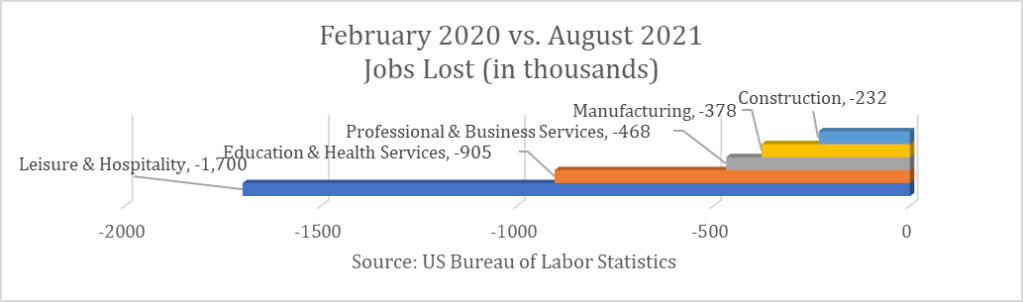
Since February 2020, the construction industry has lost 232,000 jobs. According to a U.S. Bureau of Labor Statistics report from March 2021, the construction industry needed to hire 430,000 workers in 2021 to meet demand. This has obviously been going in the wrong direction, and despite it being a topic of discussion for quite some time, the skilled labor shortage continues to be a cause for concern.
Figure 1 shows a few of the other sectors losing the most jobs between February 2020 and August 2021:
Figure 1: Jobs lost in key industries, February 2020 vs. August 2021
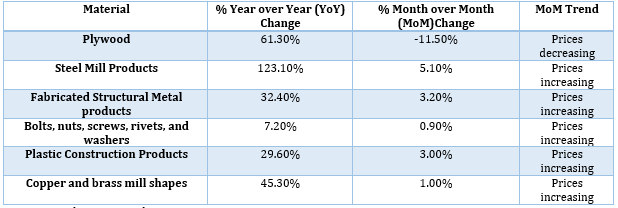
I touched on it last week, but INFLATION continues to be a topic of concern. The US Bureau of Labor Statistics quantifies inflation through their Producer Price Index (PPI). Below are a few materials and how they have been trending over the last few month.
Figure 2: Producer Price Index, August 2021 Source: US Bureau of Labor Statistics
Lastly, the ARCHITECTURAL BILLINGS INDEX (ABI) spent March 2020 through January 2021 below 50 (indicating that billings have decreased), however it has remained above 50 since February of this year, with a score of 54.6 in July.
The Takeaways:
Starting with the JOBS section.. Figure 1 shows the number of jobs lost in a few key industries. It is interesting to consider how the loss of jobs in each industry will eventually translate into the loss of building projects in those industries. Leisure & Hospitality is a good example- the industry was hit hard by the peak of the lockdowns, and travel and tourism continue to be inconsistent. It is going to take months for hotel occupancy to rise and call for more hotel construction. On the other hand, Education & Health Services is a less obvious member of the list. My personal experience through the last eighteen months has been that the higher education and health care industries are still building at a strong rate. This could be attributed to those projects having a higher backlog prior to the pandemic, but I believe that there is a need for quality institutional and health care buildings. I’m hopeful that will continue. And lastly, the decrease in manufacturing jobs is another indicator of why the building industry is having trouble finding adequate supply for the demand. It is imperative that manufacturing facilities get back to full operational capacity.
INFLATION is tied to the jobs report as well. The Federal Reserve is watching the jobs reports closely to determine when the economy reaches near-full capacity so it can begin to raise interest rates. Until that happens, demand and supply will continue to be in disequilibrium and cause higher prices and a more volatile supply chain.
And finally, the uptick in the ARCHITECTURAL BILLINGS INDEX (ABI) is a positive sign for the building industry because it means there is more design activity. The question remains, will more design activity translate into more building activity? Many contractor connections I have spoken to have mentioned they are doing more and more budgeting and “repositioning” pricing exercises over the last few months. This means there are projects in design, but the projects are not making that crucial transition into construction documents and eventually construction. Apartment complexes are the outlier in this trend as developers are continuing to build; rent pricing continues to increase, and higher rents justify new construction. Again, the question is how long will this last? It will not be forever, so this will be an especially interesting market to track over the coming months.
In summary, demand and supply will reach equilibrium, but there will be some challenging times ahead for the building industry. ABC’s Q3 economic update painted a picture of the economic landscape we are living through, and I hope this post makes it digestible for you as the reader. Use this as your cheat sheet for your next call with a client! The goal is to present you all with relevant, insightful, and far-reaching knowledge.
Inflation has been a popular topic surrounding the US Economy over the last several months. As the Coronavirus pandemic spread and shutdowns followed, the United States government enacted such fiscal policies as the Coronavirus Aid, Relief and Economic Security (“CARES”) Act and the Payroll Protection Program. Meanwhile, the Federal Reserve reduced interest rates to near zero percent. The goals of these policies were primarily to keep citizens and businesses afloat and allow for a quick recovery when the country eventually re-opened. Largely, these actions have been effective, but the sudden revitalization of the economy has also led to significant strains on the supply-chain that have in-turn caused inflation and other issues. There are a variety of ways that the economic trends of the last eighteen months have affected the construction industry, but for the scope of this paper we will specifically discuss the relationship between low interest rates, debt financing, the struggling supply-chain, and the outlook on future construction projects.
Equity financing and debt financing are two key terms for developers within the construction industry. Equity financing is the concept of a real estate developer investing their own capital, or the capital of other investors, to purchase and develop a property in exchange for an equity share in that property. Conversely, debt financing occurs when a developer borrows money from a bank or other financial institution to fund the purchase of the property (Black, 2018). There are pros and cons to each, and both forms are often utilized on your typical development project. However, when money is cheap to borrow (as is the case with near zero percent interest rates from the Fed), positive leverage increases, and debt financing becomes more attractive; Miles, Netherton, and Schmitz (2015) state that, “Such ‘positive’ leverage occurs when the cost of debt financing is lower than the overall return generated by the property.” This means that if the expected return on investment is greater than the interest rate, then justifying the decision to borrow is that much easier. Therefore, low interest rates have been incentivizing developers to utilize debt financing and continue building. Figure 1 below illustrates March 2020’s sharp drop in “Effective Federal Funds Rate”, which is the name for the interest rate set by the Federal Reserve (Chen, n.d.).
Figure 1: Effective Federal Funds Rate December 2018 – August 2021 compiled by the FRED (Federal Reserve Economic Data) Database
So far so good, right? Lower rates mean more building and more building means more backlog! That is undoubtedly true. However, as is the case with most situations, there are also costs that come with these benefits.
In this instance, the cost has been a barren supply-chain; the continued push for construction paired with the global economy’s reignition have made materials extremely difficult to obtain, manufacture, and ship. Products like polyiso roofing insulation are typically available “off-the-shelf”, but instead are taking anywhere from six to nine months to procure because of raw material shortages. Additionally, due to high demand, pricing on raw materials has been increasingly volatile with higher-than-normal levels of inflation occurring. Figure 2 shows aluminum’s one hundred and five (!) percent rise in price from April 2020 ($1,426/ton) to September 2021 ($2,933/ton). To manage the rising costs, many aluminum wall panel manufacturers have switched to a “pricing in effect” model, which means quotes are not held for the standard 30–60 day period, but rather the customer is charged the actual price of aluminum on the day of the order. This makes quoting and executing projects much more complicated.
Figure 2: Aluminum pricing December 2018 – September 2021 compiled by tradingeconomics.com
Rising prices and inconsistent supply-chain mean more risk associated with building and development. Depending on the point in a project’s construction cycle, these risks could be dispersed between developers, owners, general contractors, and subcontractors alike. However, as more contractors have become aware of supply and pricing issues, the more they are doing to protect themselves against it on upcoming projects. This will leave owners and developers with a hard decision: is it worth it to pursue a project in the current market? Would it be more prudent to put projects on hold and wait for the market to stabilize? Some are proceeding because of the cheap cost of money, but others don’t want to pay premium pricing and deal with the risks.
So how will this affect the next two to four years in our industry? That remains to be seen, but it would be sensical to assume that owners will not want to take sole ownership of the economic risks currently associated with construction projects. If distribution of that risk cannot be agreed upon, then there will be some projects that are put on hold. Meanwhile, for the economy to cool-off and inflation to decrease, interest rates cannot remain near zero forever. As a result, there is high potential for a drop-off in available work, and many contractors are recognizing that fact. It may not be felt immediately, but eventually the economic policies related to the Coronavirus pandemic will reach the construction industry.
This is a highly complex topic and the relationships described above are only a narrow snapshot of the actual picture of the market. As a result, I don’t have any type of suggested course of action, but rather wanted to bring some of these issues to light. Regardless of the complexity, it is important for company owners and leaders to track these trends and strategize when and how to secure backlog and protect their businesses.
Miles, Mike E.; Netherton, Laurence M.; Schmitz, Adrienne. Real Estate Development – 5th Edition: Principles and Process (p. 406). Urban Land Institute. Kindle Edition.
The construction industry has long had a productivity problem. Building design continues to increase in complexity, and to be effective, management of labor and supply chain must keep pace. Unfortunately, as an industry we have struggled to do so.
What is productivity and how is it measured in construction?
According to the U.S Bureau of Labor Statistics (2021), “Labor productivity is a measure of economic performance that compares the amount of goods and services produced (output) with the number of hours worked to produce those goods and services.” In the context of construction, a simple formula could be as follows:
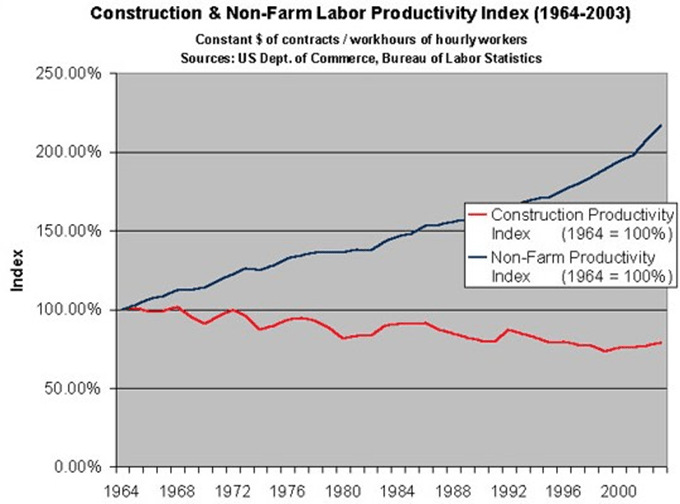
Since the construction industry has struggled to create an increasingly productive labor force, this means that onsite manhours continue to increase at a higher rate than contract value. The National Institute of Building Science produced a report (2007) noting that from 1964 to 2003, construction was the only non-farm industry to have a decline in labor productivity during that timeframe. Meanwhile, all other non-farm industries increased by over 100%! Figure 1 illustrates this divide.
Figure 1: Labor productivity index for US construction industry and all non-farm industries from 1963 through 2003. National Institute of Building Science (NIBS) 2007
Further, according to a U.S. Bureau of Labor Statistics report (2020), productivity has declined in the single-family and multi-family construction markets from 2007 to 2019. Meanwhile, the industrial and civil construction industries have shown some gains, but still lag the total economy (Figure 2).
Figure 2: U.S. Bureau of Labor Statistics, Office of Productivity and Technology
Why is this the case?
Lack of adoption of technology is an obvious answer to the productivity problem; most large general contractors are addressing the technology gap, but a significant number of specialty subcontractors are struggling to keep pace.
Another reason is that the way contracts trickle down from owner to general contractor to trade subcontractor is highly inefficient- they often create silos that incentivize each party to look out for their best interests rather than promoting collaboration and teamwork. A subcontractor may fear that pointing out a problem with a detail will lead to owning the more expensive alternative, so instead they install as Contract Documents show, knowing there will be an issue. Then, manhours and materials are wasted as each party must go through the motions of satisfying their contractual obligations rather than letting logic and transparency reign supreme from the outset.
So, what do we do about it?
In my opinion, being aware of all the waste in our industry is the first step; be vigilant and identify when it is creeping into your projects. Pay attention to how the typical, secretive nature of the owner-general contractor-subcontractor relationship serves short-term needs but causes long-term inefficiencies and delay. Then, once you recognize it, work to establish better lines of communication with those contractual parties. Set your own boundaries that are based on trust and fairness. If you must field measure prior to releasing materials, create a well-documented dimension control program that everyone buys into! Don’t just send an email saying, “You’re still not ready to measure and you have therefore caused me delay” (does that sound familiar to anyone?- I know I’m guilty). Obviously, we still need to follow our contracts, but no one is stopping us from getting the work done without bringing the contract into the fold every time there is an issue. For the sake of our industry’s productivity problem, it is imperative that this changes. But first, we need to learn to trust each other.
Authored by:
Matt Verderamo
21 September 2021
Works cited:
U.S. Bureau of Labor Statistics. (2020, September 29). Focus on productivity: Construction industries. U.S. Bureau of Labor Statistics. Retrieved September 20, 2021, from https://www.bls.gov/lpc/construction.htm.
U.S. Bureau of Labor Statistics. (n.d.). Learn about productivity. U.S. Bureau of Labor Statistics. Retrieved September 21, 2021, from https://www.bls.gov/lpc/.














 Talking Shop